

Running the Shop
How do bespoke tailors track production without chasing it on WhatsApp?
The order itself is taken at the counter. The client is measured in person, the fabric is chosen in person, the price is agreed face to face. It is everything after that which happens on WhatsApp: the measurement sheet photographed and forwarded to the master, “is the jacket ready” asked in the team group, the client messaging for an update while you go check with the floor before you can answer. You stop chasing by giving each order one record that everyone works from, where the status moves with the work instead of being asked for. The rest of this post is about how shops end up in the chase, what it quietly costs, and what the way out looks like.
Why does every shop end up running on WhatsApp groups?
Because nobody ever decides to. The team is already on WhatsApp, so forwarding the measurement photo to the master takes two seconds. A group for the workshop follows naturally, then one for the embroidery work that goes outside, then a separate thread for the second branch. Each step is the fastest option on the day it happens.
And at a small scale it genuinely works. With one master and a handful of orders, a group chat carries the load fine. The trouble is that nothing announces the moment it stops working. The shop grows, the threads multiply, and one day most of your hours are going into asking people where things stand.
What does the chasing actually cost?
It makes you the router. Every status question passes through you, in both directions. The client asks you about their sherwani, you ask the group, the master stops stitching to answer, you carry the answer back. One update, four interruptions, and two of them were yours.
The second cost is quieter. Instructions that live in chat do not live on the job. “Make the sleeve a little looser” gets said in the group on Tuesday, is read by whoever was looking at the phone, and never reaches the card pinned to the garment. When the trial goes wrong, nobody can even say where the instruction was lost.
And the chat never shows you the whole floor. It can tell you what someone answered when asked. It cannot show you every garment, every stage, at one look.
What’s the fix?
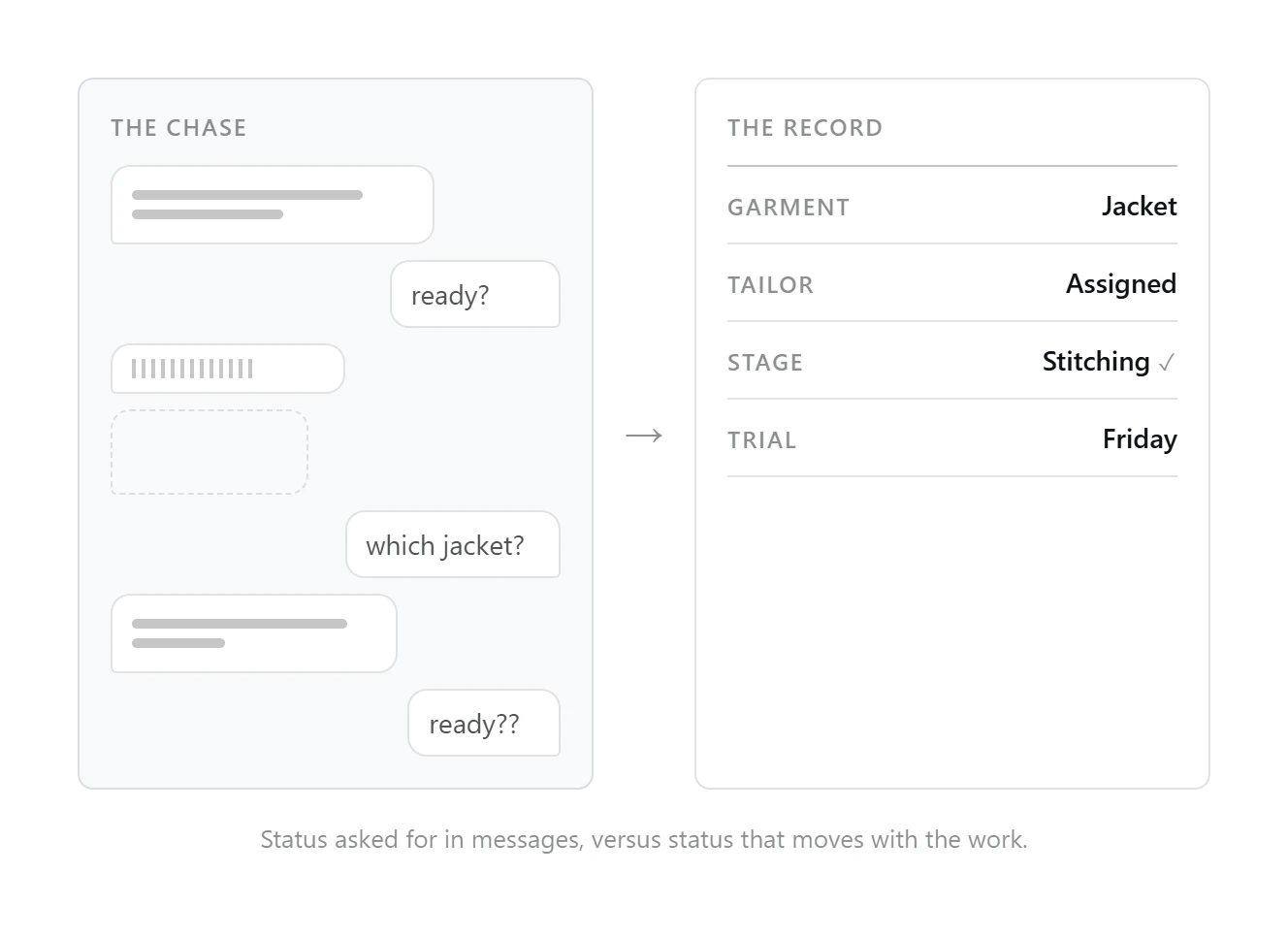
Status has to live with the order, not in messages. The order gets one record when it is booked. Each garment on it carries who is making it and what stage it is on. When work moves, the person doing it marks it moved, and everyone who needs to know can see it without anyone being asked.
That is the whole shift. Nobody stops using WhatsApp; the team keeps talking the way it talks. What changes is that the chat stops being the tracking system. Questions like “where is the jacket” stop being messages, because the answer is already visible to whoever needs it. The chase disappears not because people got more disciplined, but because there is nothing left to chase.
Where does StitchCore fit?
This record is what StitchCore is. The order is booked in one pass at the counter, client, garments, dates and charges together. Every garment carries its own tailor, status and timeline, with trial dates visible. The floor does not have to learn software: the job card that travels with the garment has a QR on it, scan it and mark the work done. A production view shows every garment stage by stage, and notifications reach only the people concerned.
The loop with the client closes the same way, without you in the middle. Updates go out on WhatsApp or email already written, and every order gets a tracking page the client can open, no app, no login. WhatsApp keeps doing what it is good at in a tailoring house, carrying conversation. It just stops carrying the production ledger of your business.
Everything here is on the features page in full. Or get started and we will set your shop up.
Quick answers
Should my team stop using WhatsApp?
No, and they will not have to. The change is narrower: WhatsApp stays for talking, and stops being where order status lives. Most teams feel the difference in the first week, because the “is it ready” messages simply stop arriving.
What about a master who will not learn software?
He does not learn software. The job card that already travels with the garment carries a QR code. Scanning it and marking the work done is the whole job, there is nothing else to learn.
Is the paper order book at the counter still fine?
For taking the booking, paper works until it does not. The strain shows up later: when a client returns after a year and the measurements are in an old book, or when the workshop needs to see what the counter wrote. The book was never the problem; the book being the only copy is.