

StitchCore
What should software for a bespoke tailoring house actually do?
Search “tailoring software” and most of what comes back is a till for a shop that sells stock. Bespoke isn’t that job. You make one garment, for one body, once, and often three garments in the same order pass through three different hands. So the honest answer is this: software for a bespoke house should hold the order the way you actually take it, keep measurements that stay good for years, carry every garment to its own trial date, and let you see production instead of chasing it. Below is what that looks like, and where the generic option quietly gives up.
What it has to do
Stripped back, the list is short. A bespoke house needs software that will:
- take the whole order in one pass, client, garments, dates and charges together
- save measurements once so they’re ready next time, not re-taken from a book nobody can find
- keep the measurement sheet the way you measure, with posture photos beside it
- hold alterations round by round, nothing written over
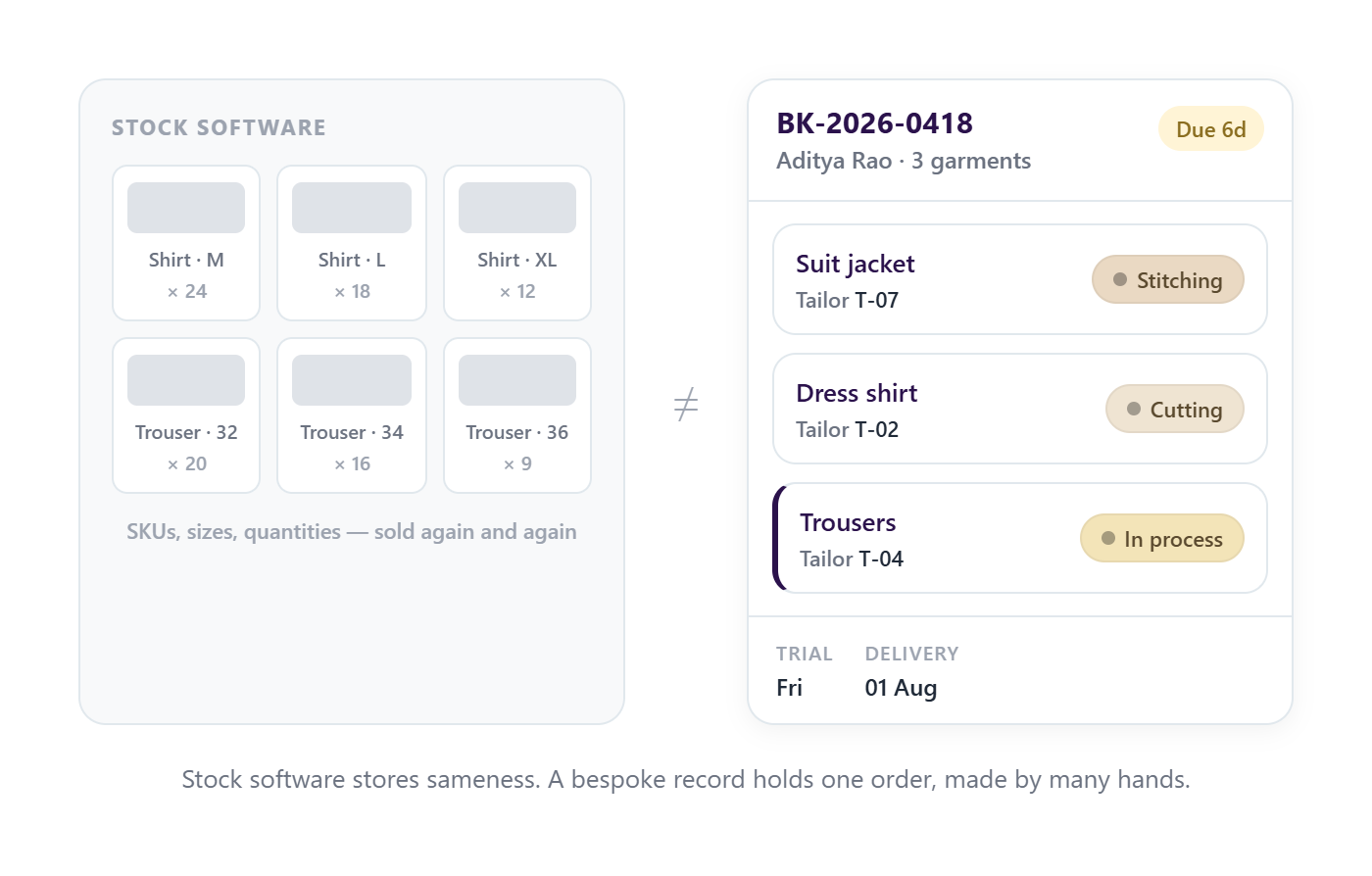
- give each garment its own tailor, stage and trial date
- show all of production at a glance
- keep the client in the loop without you standing in the middle of it
That’s the whole test. If it does those, it fits. StitchCore was built around exactly this list, which is the short version of why we exist.
Why the generic stuff doesn’t fit
Here’s what most tailoring software gets wrong: it’s built for stock. A boutique till assumes a catalogue, items with sizes and quantities you reorder and sell again. Bespoke has no SKU and no shelf. So the things that actually matter, a posture photo, a second-round alteration, a trial date for one garment out of three, have nowhere to live. They end up in a notes field. And a notes field is just your paper notebook again, with a login on top.
What it should never make you do
Just as important is what good software leaves alone. It shouldn’t drag your team off WhatsApp, and it shouldn’t hand your master the manager’s screen. The floor should get a view built for the floor: only the garments assigned to them, each opening to the sheet they actually need — measurements, style, the note that came with it — and one control to move their stage. A QR on the job card is the fast way in, jumping straight to the right garment. What the floor never sees is the office side: your prices, the client’s contact, what the order is worth. WhatsApp keeps doing what it’s good at, talking; it just stops being the place order status lives.
So where does StitchCore come in?
Right there. StitchCore is that record, built for bespoke from the order inward instead of retail billing with a new label. If you make garments one at a time for one client at a time, that’s the shape you’re looking for. The whole of it is on the features page, or get started and we’ll set your shop up.
Quick answers
Isn’t this just a CRM for tailors?
Not quite. A generic CRM stores contacts and deals, and it has nowhere honest for a measurement sheet, posture photos, round-by-round alterations or a trial date per garment. Built for bespoke means those are the record itself, not notes stapled onto a sales tool.
We make only a few garments a month. Is software overkill?
The value is memory, not volume. Even a few bespoke clients come back a year later expecting to be remembered, so measurements saved once and ready next time is worth more at low volume, not less.
Will my master have to learn software?
No. His screen is built for the floor, not the office: it shows only the garments he’s making, each with the measurements, style and notes he needs, and one control to mark his stage. The job card’s QR jumps him straight to the right garment. He never touches prices, client contacts or anyone else’s orders.